
Search
Total: 99 results found.
Page 3 of 5

User Forum on Frailty Prevention
[…] there is evidence to suggest that the term ‘frailty’ does not resonate with older people, nor is it something that they identify with. […], as a result, fewer older people may access the health and social care that they need.
Early detection, prevention and management of frailty: Introducing the FrailSafe system
Frailty is one of the most challenging age-associated conditions. Hence, it has aroused considerable research attention over the past few years.
FrailSafe Q&A

What is the frailty syndrome?
Frailty is a biological syndrome of decreased reserve and resistance to stressors, resulting from cumulative declines across multiple physiologic systems and causing vulnerability to adverse health outcomes. Frail older people display low resilience to minor stressors (e.g. urinary tract infection). Adverse health outcomes include disability, morbidity, falls, hospitalization, institutionalization, and death. Frailty is a dynamic and not an irreversible process; it seems preventable, may be delayed, or reversed.
Which are the baselines of operation of the FrailSafe project?
FrailSafe tries to delay the effects of frailty or even reverse the progress of the syndrome by using data generated by patients during their daily life (e.g. collected via wearable devices) and an advanced online platform which analyzes this data and suggests interventions.
Describe the FrailSafe solution; How is the project going to solve the problem?
FrailSafe aims to delay or reverse the effects of frailty by using advanced technological devices to monitor patients' daily life. By continuously collecting user-generated medical data of multiple sources (physical, cognitive, behavioral, psychological, social, etc.), the FrailSafe system can complement the comprehensive geriatric assessment by analyzing and quantifying the frailty level of each person and hence provide suggestions for personalized interventions based on each person’s condition. The interventions are provided through a suite of serious games (some of which are virtual and augmented reality) challenging accordingly physical, cognitive, psychological, functional and social domains, through recommendations regarding lifestyle, daily activity, exercise, nutrition etc., by providing assistance to comply with medical recommendations and facilitating the adjustment of drugs or drug dosage by the physician based on the objectively measured parameters.
Additionally, a new frailty measure that is quantitative and qualitative is being developed. Real-time data processing enables the FrailSafe system to immediately detect dangerous and emergency events (e.g. falls, loss of balance, loss of orientation etc.) and alert people’s families, their personal caregivers and the emergency department via suitable messages.
What are the advantages of the FrailSafe solution? Describe what is innovative in the project idea.
The project is based on real-life medical data which are continuously generated using wearable devices, unlike other solutions which use one-off medical data, not always representative of the patients' condition.
The big shift compared to other similar solutions is the innovative back-end platform which processes and analyzes all personal data using deep-learning algorithms which can quantify people’s frailty level and locate the weakness areas of each person in order to provide personalized suggestions.
Moreover, other solutions do not consider all the domains we consider in FrailSafe, i.e., physical, cognitive, social, behavioral physiological, psychological. A great advantage of our solution is that it relies on a novel frailty metric that can be used to predict short and long-term outcomes and risk of frailty.
Who is the targeted customer paying for the FrailSafe solution, e.g. patient, hospital or care center, insurance companies etc.?
The main customers are expected to be the medical professionals (hospitals, clinics, doctors etc.) who will be given access to the platform to monitor their patients' medical data and assist them in dealing with their syndrome, along with health insurance companies who will greatly benefit by reducing their costs and liabilities due to significant drop in hospitalization, institutionalization and social care expenses derived from early detection and prevention of frailty symptoms.
Ultimately, health insurances and the public and private health system can pay the foreseen expenses since they will benefit from the prevention of adverse health outcomes of older people. Healthcare staff needs to get involved to overview the daily activities, check the uploaded data, suggest the most appropriate interventions given the data collected, monitor the results of interventions, execute physical exams, etc.
Secondarily, some additional options will be given to users/patients on a paid subscription for advanced features and services, e.g. advanced features for data visualization.
Which is the followed monetization strategy? What exactly do users pay for? Is it just the mobile app, the data coming out of it etc.? Are any additional services offered on top of them?
Monetization is done through selling access to the FrailSafe platform which provides all the features to both end-users and medical professionals. Older people and their families (end users) will greatly benefit from continuous remote monitoring and saving time from frequent in-person checkups, while medical professionals will be assisted by the FrailSafe solution in their treatment suggestions and have large amounts of data for better assessment. An additional business model has been designed for long-term perspective, where only (anonymized) data will be provided to third parties who wish to access data sets collected in real-life conditions to inform their own projects (the platform's medical data after 2-3 years with thousands of patients' data). This model will be suitable for insurance companies, researchers etc.
How many users are required for the solution to make sense economic wise? Which is the volume of data points which guarantee data validation?
A rough estimation is that an initial customer base of 5.000 older people (4.500 free accounts plus 500 paid monthly subscriptions) and 50 medical professionals/insurance companies (all of which with paid subscriptions) will make the app business financially viable and will provide a broad enough data sample for the deep-learning algorithms to be trained in order to provide validated results.
Are there any competitors doing the same thing with the FrailSafe solution? How do you envisage to differentiate?
There are numerous projects/systems dealing with innovative ways to detect geriatric issues (including the frailty syndrome) using ICT devices. To our knowledge, what makes FrailSafe unique is that it employs both physical medical data (collected via wearable devices) and data analysis of other sources of older people's activities (psychological, behavioral etc.) in order to measure their frailty level and monitor progress. Additionally, this analysis is not static, but continuously re-evaluated using other people's data to self-assess the accuracy of the method.
The main differentiation of FrailSafe compared to other developed/developing solutions is its real-time data capture which eliminates the need for older person to frequently visit her/his personal doctor but being assured that both the doctor and the system are remotely monitoring her/his condition 24/7. Furthermore, the feature of automatic instant alerts (to family members, caregivers, doctors, nurses etc.) in case of life-threatening adverse events (falls, loss of balance, loss of orientation etc.) might be life-saving for many older people. The global results of the adoption of the FrailSafe solution would be to eliminate the cost for both society and individuals and improve the daily life of older people.
What is the value proposition for each targeted user group?
The value proposition for individual patients include real-time data monitoring and alerts, personalized suggestions for interventions based on their condition, real-time communication with their doctors or other patients via the online platform etc. For medical professionals, the value proposition is based on the possibility to have real-time access to their patients' daily data and have their entire medical history available at any time for better adaptation of their treatment. Additionally, FrailSafe will act as their marketplace for acquiring new customers/patients who need the advanced monitoring capabilities offered by the online platform.
Have you conducted a cost-benefit analysis? What are the estimated savings for the healthcare system, the society, the patients etc.?
A representative example follows: It is estimated that the cost of falls alone in older people due to frailty syndrome in the EU is more than 40 billion euros on an annual basis, which includes hospitalization expenses, social services cost and rehabilitation cost. This cost is covered by the national health system, the private sector (e.g. insurance companies) and individuals themselves. The target of the FrailSafe solution is to lead to a significant reduction in falls among those equipped with the FrailSafe solution, the vast majority of which occur at home and, thus, result in significant cost reduction for fall-related injuries alone. This is expected to be made possible through the early detection of increased frailty levels in older people far earlier that it is possible today using the traditional methods. Additionally, deep data analysis will produce personalized suggestions for improvement of fields that each person is weak at, e.g. foot exercise in case of low gait speed. All these innovative features are estimated to have a large impact on the way frailty is treated and people are ageing.

Looking into the future of later life
Ingrid Eyers FHEA PhD MSc RGN
Independent Expert: Policy and Practice in Care of Older People

Simon 2.0 for frailty prevention
Brainstorm Multimedia designed a specific game to evaluate and stimulate the memory of people afflicted by the syndrome of frailty.

Reflex game developed by FrailSafe
Cognitive skills are an important aspect to be measured when it comes to frailty.
FrailSafe Webinar: Game changer in frailty prevention
On 18 April 2018, a webinar was organized for the members of the EIP AHA A3 action group dealing with functional decline and frailty.

Frailty detection from text analysis
Within the FrailSafe project, researchers from the University of Patras have developed a frailty detection model that takes texts of older people into account.

Future plans for FrailSafe
The FrailSafe project developed an integrated solution consisting of wearable devices, mobile phones, tablets, a cloud-based website and a mobile app, all combined together through a sophisticated data-analyzing platform.

The commercial value of FrailSafe
Population ageing across Europe has resulted in increased expenses for healthcare systems. In terms of costs due to fall-related injuries, heart failures, depression treatment, frequent medical screenings etc.
FrailSafe Webinar announced: Game changer in frailty prevention
18 April 2018 at 10.30 - 12.00 (CET)
FrailSafe meeting the EIP AHA A3 Group on frailty prevention
On the 23th and 24th of January 2018, the FrailSafe consortium participated to the EIP AHA A3 action group meeting,
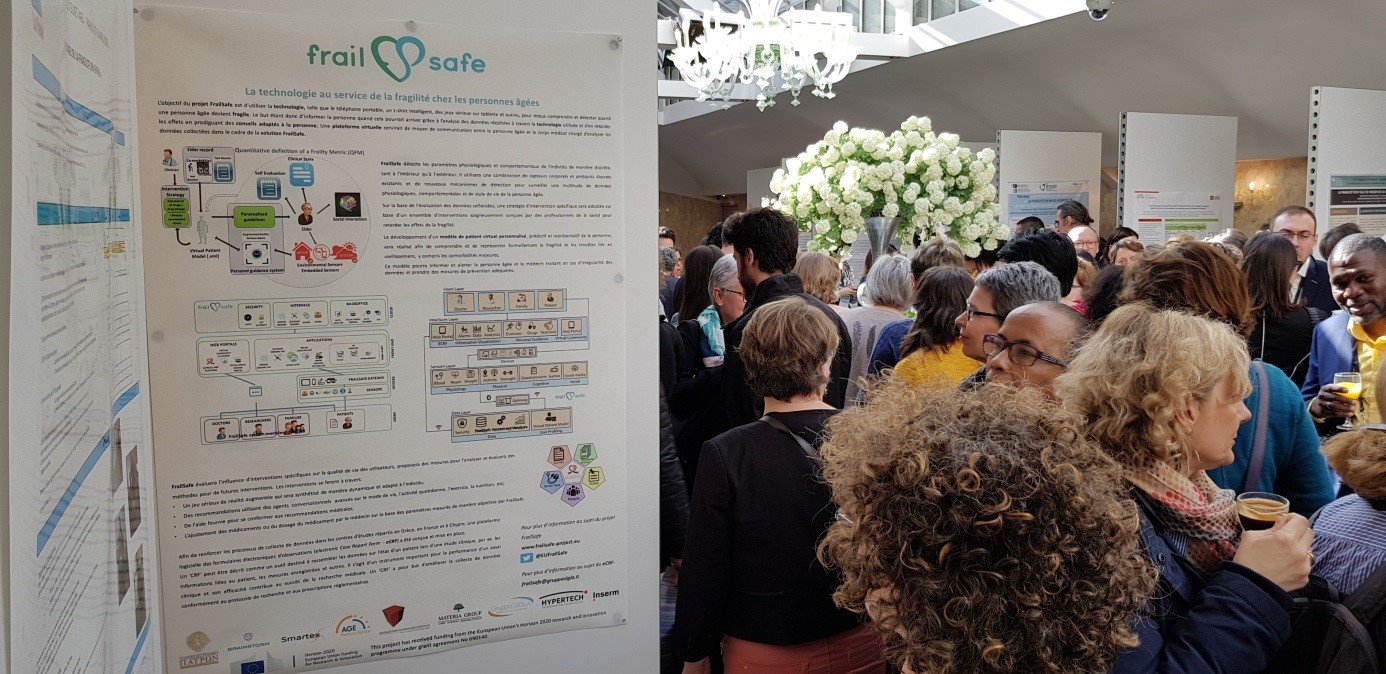
French Congress on Frailty among Older People
Our French partner, INSERM, represented FrailSafe at a Congress on frailty among older people in Paris on 5 and 6 April 2018.
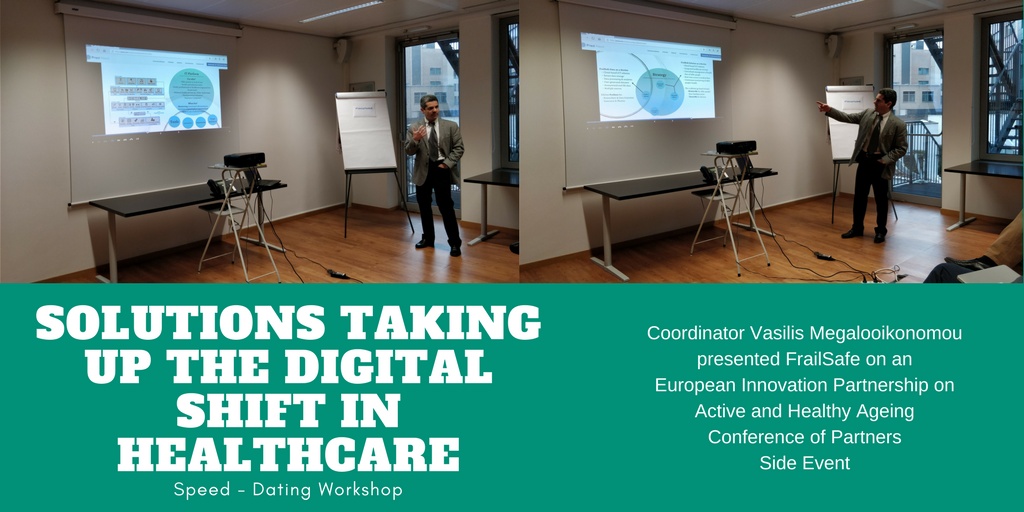
Solutions taking up the digital shift in healthcare
The Occitanie Europe regional office hosted an engaging side event to the European Innovation Partnership on Active and Healthy Ageing Conference of Partners on 26 February 2018.

Indoor Localization application
The symptoms of frailty can be detected not only through the clinical measurements of physical or cognitive properties of an older person, but also through behavioral parameters.
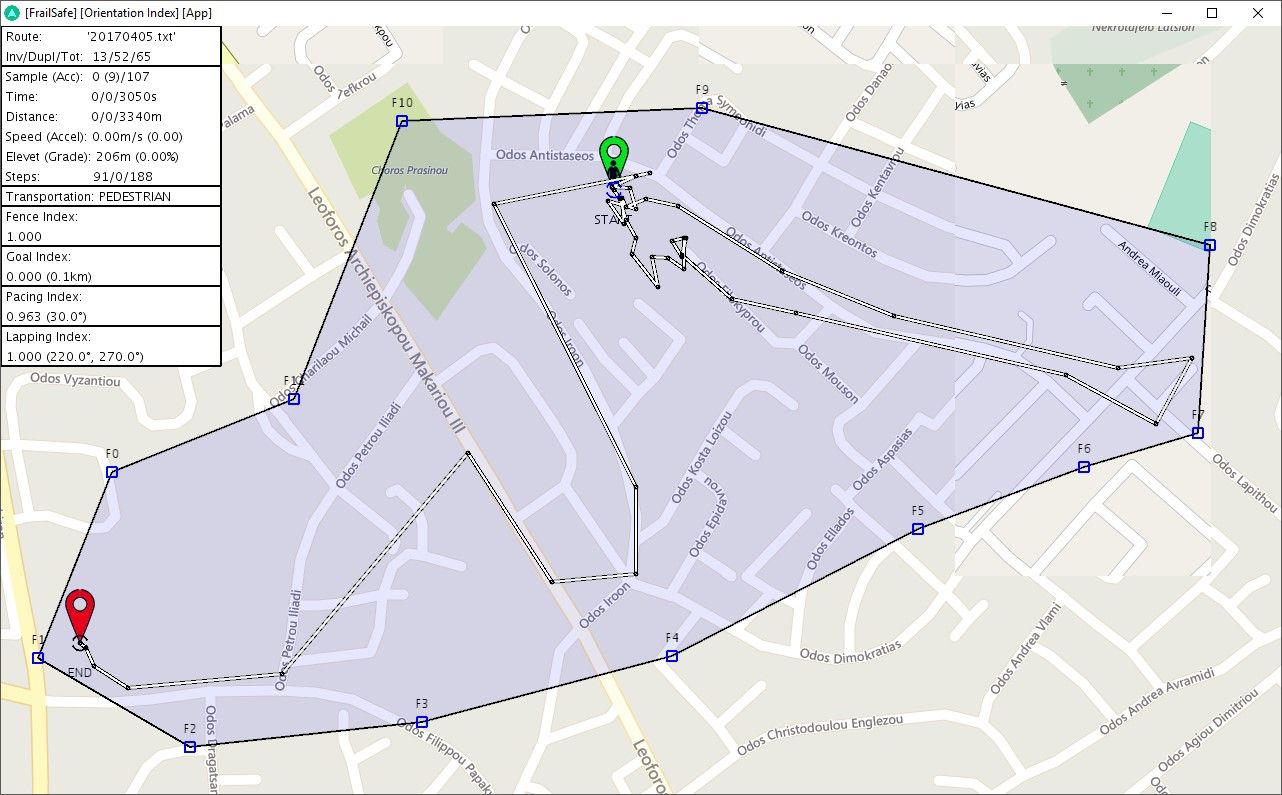
Loss of Orientation application
The Loss of Orientation is a potentially life-threatening and a common behavior seen among older people, specifically people with Dementia and Alzheimer’s.

Using advanced informatics to turn the tables in frailty
As a matter of fact, frailty is unavoidable. Each and every one of us will experience it at some point in later life, but its duration and the impact it will have can vary significantly.

Welcome to the 4th issue of the FrailSafe biannual newsletter!
2017 has not only been a year of fine-tuning the tools, devices and architectures developed in 2016, but also the time when new applications were created to complete the FrailSafe system.

The FrailSafe Smart Vest 2.0
The Italian-based company, Smartex, is the partner who designs and creates the wearable sensor device WWBS (“Wearable WBAN system”) used by the clinicians in the FrailSafe study. It measures individual medical parameters related to heart, respiration and physical activity.

What do FrailSafe nurses think of FrailSafe?
The FrailSafe study is taking place in three different pilot sites: Patras (Greece), Nicosia (Cyprus) and Nancy (France). A medical team, composed of general practitioners (GPs), psychologists, neurologists, and nurses, follow the volunteers that signed up for the study. This time, we wanted to have the perspective of the nurses working on FrailSafe. Rafaela Tsela, from the Patras site, and Anne Freminet, from the French site INSERM, were interviewed to know what their work consists in in the framework of FrailSafe and what they think about the potential of the project.