
Search
Total: 99 results found.
Page 4 of 5
FrailSafe Ethics Supervisor
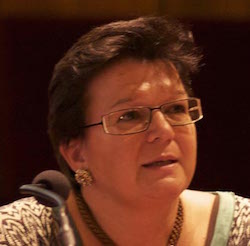
Professor Stefania Maggi is serving as the Ethics Supervisor of FrailSafe. Prof. Maggi is a Geriatrician and Epidemiologist with expertise in both areas of Clinical Geriatrics and Epidemiology of Aging. Her research focuses on the epidemiology of aging and on the analysis of the impact that lifelong health promotion and disease prevention programs have on healthy aging. She is a Board-Certified Geriatrician (University of Padua, Italy) and also obtained a Master in Public Health in Epidemiology in 1987 and completed a two-year Post-Doctoral Training in Epidemiology, both at the Johns Hopkins University, in Baltimore, MD, USA. Prof. Maggi was the Coordinator of the Program for Research on Aging of WHO, from 1990 to 1993, based at NIA, NIH, Bethesda, MD, USA. She is currently working as Research Director at the CNR Aging Branch-Institute of Neuroscience in Padua and is the Director of the CNR Project on Aging, involving 22 multidisciplinary, research centers in Italy. Over the year, Prof. Maggi has created a large international network, leading to the implementation of cross-national research projects. Since 2001 she is a member of the Board of Directors, American Federation for Aging (AFAR), New York, NY, US, and since 2010 Director General of the Mediterranean Diet Foundation. Prof. Maggi has been the Academic Director and is currently the President of the European Union Geriatric Medicine Society (EUGMS). She is the author of about 300 publications in international journals of Medicine and Public Health and is Editor in Chief of Aging Clinical and Experimental Research.

FrailSafe, viewed by the Cyprus volunteers
FrailSafe is testing out its study among volunteers in three different sites: Nancy, Patras and Nicosia. In June, the consortium partners were gathered to discuss the state of play of the project and took the opportunity to visit one of the pilot sites. Three volunteers agreed to be interviewed and discuss their participation in the study.

Welcome to the 3rd issue of the FrailSafe biannual newsletter!
Since the last newsletter, the Consortium partners have worked to set up a first version of the FrailSafe system and have developed a couple of games to support the FrailSafe study for the volunteers to play. The latest achievements are detailed in the present newsletter.

FrailSafe Smartvest
FrailSafe partner Smartex has completed the development and production of the "Wearable WBAN - Wireless Body Area Network - System" (WWBS) designed to measure individuals’ medical parameters. The system is composed of a sensorised garment, an electronic device and a software tool for visualisation of streaming of data or downloading the recorded data from the electronic device to a PC (and then uploaded to a cloud service).

Serious games for frailty detection
To successfully support the FrailSafe study, a series of serious games will be designed. The first FrailSafe game, the Virtual Supermarket game, was released last December and is used to detect Mild Cognitive Impairment (MCI) among our older volunteers.
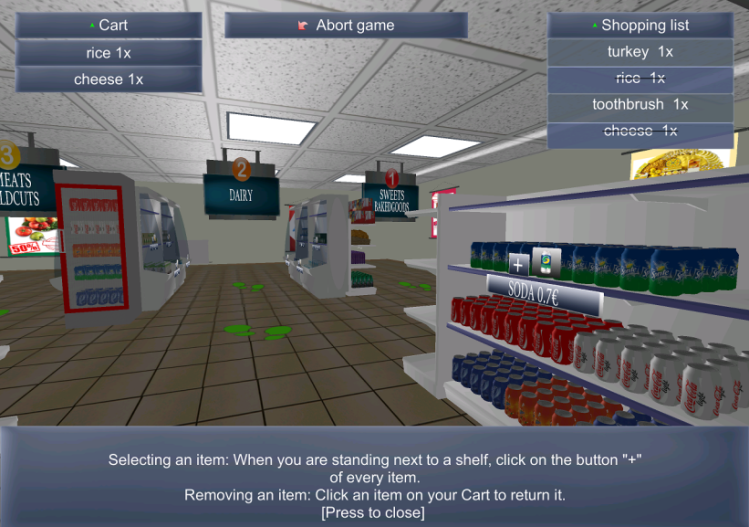
Virtual Supermarket game
Games with a purpose are invaluable tools to encourage the user participation in health monitoring applications. The usage of games for monitoring the physical and cognitive status of older persons is a core concept of the FrailSafe project.
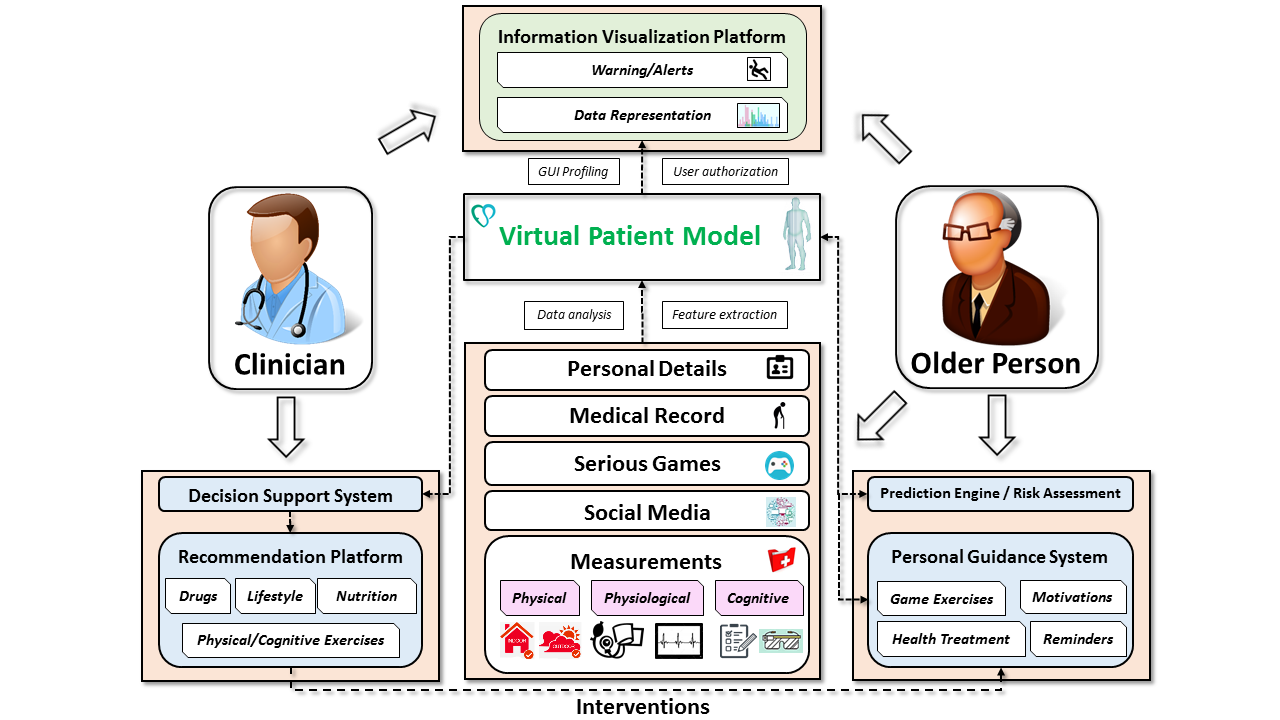
FrailSafe's Virtual Patient Model (VPM)
One of FrailSafe objectives is to generate reliable advanced intervention services and determine the risk of triggering events that would make a person tip from the pre-frail category to the frail one.

FrailSafe's Electronic Case Report Form (eCRF)
The main objectives of FrailSafe is to better understand frailty and be able to recognize common patterns through data collection that would explain when a person tips from the non-frail to the frail category.

Materia Group, a Care Service Provider for Older Adults in Cyprus
Cyprus counts among the smaller countries in the EU, and even though it used to present a historical positive development, the country couldn’t prevent a significant economic setback brought by the 2012-2013 financial crises. Health in general, and healthy ageing in particular, haven’t been preserved by the setback.
Welcome to the 2nd issue of the FrailSafe biannual newsletter!
The FrailSafe project has been going on for almost a year now.

FrailSafe plenary meeting in Genova, Italy
FrailSafe partners met in 12-13 December 2016, in Genova, Italy to examine project status and define next steps.

FrailSafe in the "Open Doors" event organized by ONPA
The French partners of FrailSafe are working very hard to raise awareness about the project. One of the occasions was an “Open Doors” event organized by ONPA (Office Nancéien des Personnes Âgées), a local French association for older people, on 30 June and the 1 July 2016. Given the target group of the ONPA, it goes without saying that FrailSafe French partners, represented by a group of investigators from INSERM and the Geriatric Department of Nancy’s University Hospital, are closely working with the association.

FrailSafe featured in Horizon magazine
We are glad that the Horizon magazine, the European Union’s Research and Innovation Magazine, has published the article "Frailty indicators could help prevent problems with ageing", which features our work on the FrailSafe project.
Welcome to the 1st issue of the FrailSafe biannual newsletter!
Many health specialists often compare frailty to a popular game called Jenga. The aim is to pull out one block at a time from the tower until the structure is too fragile to remain standing. As we grow older, our body does not recover as quickly as before and each infection, fall or hospital admission can be represented by one missing block on the Jenga tower, weakening the whole structure until it eventually collapses. As each and every one of us age differently, with different genes and lifestyles, detecting the point of no return becomes extremely difficult.

Next FrailSafe plenary meeting in Thessaloniki, Greece
FrailSafe partners will meet in 1-2 June 2016, in Thessaloniki, Greece, to discuss project progress and next steps.

FrailSafe at IARIA 2016 International Conference
During the IARIA Conference on Digital Healthy Living on 24 to 28 April 2016 in Venice, Gruppo SIGLA and the University of Patras, represented by Dr. Vasilis Megalooikonomou, were at the international conference to present FrailSafe.
University Hospital of Nancy and INSERM U1116 Nancy

The territorial community hospital of Lorraine is composed by the University Hospital of Nancy and the Regional Hospital of Metz (the “sillon Lorrain” hospital). 2012 key figures of the university hospital of Nancy are the following: 1664 in-patient hospital beds and 68487 in-patient hospitalizations for an average stay of 7,1 days; 175 801 medical outpatient consultations. The Geriatric Department of the University Hospital of Nancy includes extremely competent physicians who are very involved in the life of the establishment with a view to offer to elderly patients the highest quality of care in a modern and warm environment and participating also in teaching, research and information. The Nancy group, affiliated to the INSERM Unit UMR S1116, is involved for many years in the evaluation and the management of old frail patients. This thematic is actually one of the main scopes of the Federation Hospitalo-Universitaire (FHU) on cardiac and arterial aging CARTAGE (www.fhu-cartage.com) the Nancy group coordinates.
In the context of the project, the Nancy team will contribute to the definition and detailed evaluation of the markers of frailty and the development of instruments that would be useful in various clinical settings. The generally accepted definition of frailty, “A biological syndrome of decreased reserve and resistance to stressors, resulting from cumulative declines across multiple physiologic systems and causing vulnerability to adverse outcomes” mirrors the definition of aging, although chronological age is only one factor that predicts a vulnerability to frailty. Susceptibility to stressors also is influenced by biological, behavioural, environmental, and social risk factors, with the main consequence being an increased risk for multiple adverse health outcomes, including disability, morbidity, falls, hospitalization, institutionalization, and death. Our understanding of frailty has markedly improved over the last five years, yet there are many issues yet to be resolved. The challenge is now to develop a research strategy that would move the field forward within the next few years by defining frailty markers and developing instruments that would be useful in various clinical settings. Ultimately, these tools will be most relevant if they accompany effective health promotion, prevention, treatment, rehabilitation, and care interventions. Presently, a number of clinical studies show that detection of frailty may predict probability of events such as mortality, major morbidity, length of hospitalizations and loss of autonomy but also can define the benefit/risk ratio of therapeutic interventions much better than the chronological age. Nancy group will focus on proposing assessment tools that can be administered quickly and easily by general practitioners, nurses, pharmacists, home health providers, social workers, and other health care workers. A positive screen would indicate the need for more detailed evaluation of the markers of frailty to enable tailoring of interventions to the patient.
Hypertech

HYPERTECH, founded in 1997, is one of the pioneers in the Internet and Mobile applications area. The business strategy of HYPERTECH focuses on applied research and innovation activities to create a full suite of services and products appealing to enterprises and organisations while at the same time being able to meet real customer needs.
HYPERTECH is a dynamic SME, fully adapted for the new economy and continuously invests, as a strategic decision, in bringing innovations to the markets it addresses, and in acquiring knowhow by closely following the state of the art in the technological domains of interest. Today, HYPERTECH is applying this experience to the following three disciplines:
Enterprise IT Solutions
HYPERTECH enterprise IT unit's mission is to help organisations and enterprises uncover, at its full potential, the hidden value of their data and processes. HYPERTECH focuses on the following main topics:
- Business Intelligence and Analytics, building advanced services that leverage open source technologies, allowing the process and analysis of structured or raw data sources, in order to enable enterprises and organizations to make better business decisions and verify or disprove existing models or theories of operations.
- e-Learning, combining modern social learning management systems with the knowhow of building and delivering the right educational experience, offering significant opportunities to today's organisations to enhance their potential and intellectual firepower.
- e-Culture, supporting digitisation and scientific documentation services, digital asset management as well as advanced application services for the promotion and dissemination of collections and archives: mobile applications serving as indoor or outdoor multimedia guides, 3D animation applications for stereoscopic screenings, virtual tours, serious games, interactive digital signage with touch screen displays.
Digital Life Apps & Services
The extensive experience in secure internet and mobile applications for a diversified portfolio of clients, combined with state of the art AI and user profiling tools provides HYPERTECH with the ability to define and solve effectively the right problems in the fields of social media, mobile applications and games. HYPERTECH is investing consistently and heavily developing applications on the following indicative areas: Mobile Video (peer to peer) & Augmented Reality, M2M applications, Wearable Computing and User Profiling. HYPERTECH has also developed a concrete and proven methodology, which allows the development of well-designed tailor-made gamification projects and integrates a powerful gamification engine that enables the creation of customizable learning games for further enhancing user engagement.
Smart Energy Solutions & Products
Since 2010, HYPERTECH’s Energy Labs unit focuses on designing and developing innovative solutions for automated analysis of consumer profiles as well as the development of intelligent and automated techniques for real-time balancing of supply and demand of electricity. HYPERTECH Energy Labs aim at providing flexible solutions for small and medium-sized electricity consumers and integrated solutions for electric utilities and service providers in the field of demand management.
Since its founding, HYPERTECH has invested in research & development and has achieved to remain at the forefront of ICT technology, successfully transferring the resulting innovations and acquired knowhow into its products and services. HYPERTECH has been actively involved in EU funded R&D programmes and has been participating as main technology partner in several Horizon 2020, FP7, Lifelong Learning, Eco-innovation as well as national R&D projects.
Gruppo SIGLA
Gruppo SIGLA Srl, established in 1990 in Genova (Italy), is an Italian SME consisting of 70 specialists with high technical expertise and experience in the field of ICT. Gruppo SIGLA provides IT solutions, covering the entire lifecycle: from the analysis of the customer requirements to the implementation of feasibility studies, from the design (hardware and software) to the integration and configuration of the systems, from the development of "software dedicated applications" to their installation and delivery to the end users. Particularly, in the field of Automation, Gruppo SIGLA confirms its role as a partner of the market-leading companies for the provision of design, configuration, development and commissioning services in the industry fields.